Sometimes we need to learn things first hand to “get it.” I was one of those people who vaguely knew who the Zapatistas are and what the Zapatista Army of National Liberation (EZLN) is all about. So I went to meet them, and had a fabulous time.
Very briefly, the Zapatistas work to create local economic and social systems in response to the oppressive nature of neoliberalization. They have worked for decades to build local health, education and political  systems in Chiapas, Mexico. And now they are on “The Other Campaign” to connect with local and native people across Mexico.
The Other Campaign is a brilliant strategy of grassroots mobilization. The Zapatistas are basically on a “listening tour,” moving from state to state calling together indigenous people and other activists to share their grievances, concerns, traditions and ideas with each other. The Zappies are the sparks and the threads from place to place.

I met them in Magdalena, in the State of Sonora, Mexico. During the weekend event, we listened to dozens of people speak their truths, and I was completely enthralled for hours and hours!
Click here for my story and photos of my adventure with the Zapatistas!
An enounter with the Zapatistas
We arrived at the eco-hostel ranch in Magdalena at about 3pm on Saturday, joining the other carloads of eager young activists from Tucson. Little by little, locals and nearby indigenous communities began to arrive.
 I walked around and got a feel for the place and general vibe of the people. To one side of the central building was an outdoor kitchen, fire cook pits, lots of tables and chairs under some nice shade trees, and a few people enjoying the big pots of beans and rice ready for hungry travelers. In the distance beside the hostel/ranch was a big, reddish cliff with a three story Virgin of Guadalupe painted on it.
On the other side of the central dirt area, where a few men from the Tohono O’odham tribe were starting a ceremonial fire, was a covered pavilion with many rows of plastic Tecate-sponsored chairs facing a long table in front. Next to the pavilion were some very noisy goats.
 I quickly got into a conversation with a smiley man named Carlos, a therapist (what kind? all kinds) from Nogales, the city on the border. He was one of those people who you immediately like, full of energy and eyes that listen. His sense of inner peace emanated gracefully.
The conversation revolved around the concept of changing ourselves before we can change the world -- a great start to a sacred weekend. This was a reminder to me about my own path, my own journey as an organizer and as a Saturn-returning woman. This is an essence of my personal struggle: to find my own sense of personal peace (including things like taking care of my body – he told me I should do a cleanse and clean my skin thoroughly, and I agree!) in the midst of my work as an activist. This is all of our struggles, no? So, to invoke this concept – that it starts with myself – at the beginning of this weekend, was quite apropos. Also, one year ago that day I began my three-month ritual for turning 28, which led to this year of wandering. I guess I should write about my ritual journey another time, but for now I will just say that it was quite synchronistic that this was the weekend that I went to Mexico to meet the Zapatistas, including sb.Marcos, to journey sola and freely flow with the go, and to let what happened happen.
So anyway, it was wonderful to meet Carlos. A few other things from our conversation: he taught me a peace exercise (basically, clench every muscle of your body and then let it go, a few times over) and we discussed how women are stronger than men and just don’t use our strength. Also, he said that if there’s something I can accomplish, I should get up early, put on my tennis shoes and get out there and do it. But don’t try to do what I can’t accomplish. He also said it’s always important to abandon the ego, the need to be the important person. Good stuff.
 Next I met Martin, a professor of Mexican Literature at the University of Sonora (Mexico). At first we just had a nice conversation, kind of light. He seemed a little hesitant to share much, which only increased my intrigue, of course. I kept asking him questions, and he also inquired about me. I told him about my journey as a wandering organizer, looking to learn from/share with other grassroots efforts… and of course linking to the event happening around us (more people arriving, anticipating the arrival of the caravan). He told me about his poetry, and asked if I had read any of Marcos’ writing. Finally, he turned to me with a glint in his eye and said solidly, “I am a Zapatista with La Otra Campana.” Yes, a little rush went through me (I feel like such a starry-eyed little girl saying this)… this was why I was there: to meet people, individuals, and make personal connections, share stories, talk shop. It was a moment of “yes!,” I had made a friend, was building trust and connection with him, and we were both there to be there. I have to say that it was quite exciting talking about “the revolution” in such in a very real and direct, literal way… I mean, that’s why we were both at this event – this IS the revolution.
 Then the EZLN caravan pulled in. Of course, everyone waiting around got all excited and started gathering around the bus to greet the caravanistas. What was interesting to me was how quiet it all was… folks silently piled out of the bus and accompanying cars (a myriad of revolutionaries: young people in black, older folks in cowboy hats, women in traditional clothes etc.) and people around were q
 uiet, too. Finally a blob of people moved from one side of the bus towards the door of the main building: Marcos in the middle. Everyone wanted to see him. Digital and video cameras were everywhere. And all was quiet, very quiet. It was interesting.
So Marcos and the Zapatistas disappeared for a few hours to eat, rest, and meet with the local organizers. I was present and happy to wander around and talk to folks; after all, this is what I think the revolution is all about: connecting with people and going from there.
Martin and I struck up our conversation again and he invited me to Hermosillo, where he is from, to “know my country, my people,” to see for myself. Turns out he was organizing the Otra Compana event happening at the University on Monday. I told him I’d think about it and talk later. Oh to be a wandering traveler!
 I next met Mel and Otis, the Tohono O’odham men at the fire. They were preparing for the opening ceremony and blessing that would begin the evening’s events. I learned that their reservation is on both sides of the border and they are having increasing problems both with Border Patrol and with migrants who are leaving a lot of trash through the desert. I also noticed that they didn’t speak much Spanish, though most people assumed they did.
 Finally it got dark (after a beautiful sunset on the red saguaro-filled cliffs and the giant Virgin painting).
  And then Marcos appeared and the mass of starry-eyed (but still quiet) people gathered round and moved slowly with him to the fire.
The welcoming blessing and ceremony was good, as I expected, moving. Mel smudged about 25 people with some feathers… first Maria (the event’s organizer), then Martin (my new friend), then another guy, then Marcos, and many more. They all stood in a line around the fire. Drumming and dancers celebrated where we were, and blessed the event. At the end the dancers yelled (en espanol), “our hearts are of corn, our bodies are of corn, are souls ARE corn.” Then they yelled, “VIVE ZAPATISTA! SIGUE LA LUCHA” and the crowd joined in: VIVE! VIVE! SIGUE! SIGUE! Thus began the event.
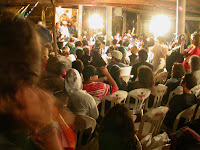 We all moved into the pavilion to begin the testimonials. I was present and enthralled for the next five hours. I hardly moved. One at a time, representatives from native tribes came forward and spoke about the issues of concern for their communities, and of their appreciation for the chance to speak, be heard and be part of the Zapatista movement. People spoke in Spanish or their native languages and each time was translated into the Spanish (if native) and English. I was pleased at how much Spanish I still remembered and could follow.
Here are some of my notes:
~ We must work for justice. The government cannot break our souls.
~ From the governor (?) of the Mayo nation: the seven tribes in the state of Sonora have no housing and access to education. Megadevelopers and squatters are encroaching on their land,
~ A Ho’akum man: “The border was established without our consent”… their native land is on both sides, lots of problems now… to the north they face forced assimilation and to the south they face poverty. Not to mention more harassment from the Border Patrol, as they just try to live their lives on their land.
 ~ Someone spoke of how a non-indigenous woman was put as their representative (to the Mexican or local gov’t I assume) and this woman was not their chosen representative.
~ Toxic pollution is a major problem for many tribes, from major corporations
~ A young Navajo woman spoke first in her native language: it was one of the most beautiful sounds I have heard. Fascinating how many sounds we humans can make. She leaned towards the crowd and spoke slowly and simply, in a way that went directly to the heart. “O u r g o v e r n m e n t w i l l n o t l i s t e n t o u s.” Somehow that simple statement struck deep.
~ Then a man from Pheonix who works for a non-profit that supports indigenous causes started speaking and after a few moments an elder woman in the second row and said quietly but strongly (in her native language), “he is not native. He should not be allowed to speak here.” People all leaned forward to see what would happen, and the MC-type guy (an older indigenous man) stood up and spoke for a long time. I only caught some of what he said, but the gist of it was that anyone should be allowed to speak for the cause. I noted that Marcos stayed out of it, quietly writing.
~ Mike Flores, from the Tohono O’odham Nation spoke about the Border Forum that they had a few weeks ago, and that they webcasted it and people from all over the world responded in support. He got calls from Costa Rica, Germany, Italy, and was quite moved by this.
 ~ A chicano student from the U.S. said, “we are indigenous to a land north of here but we are strangers in that land,” noting another aspect of migration, acclimitization, etc.
~ “the Zapatistas remind us that reality is hard and that we have to work to change it for everyone.”
And then I started thinking about things, as I was listening. Things like:
* I noted that the Zapas and Marcos inspire people to fight, to struggle. Yes, this is quite an obvious and mundane thing to note, but I share it to remember the feeling of inspiration… what this actually means.
* I felt proud of City Repair and TLC Farm and our work for local power.
* A woman from Oakland talked about her group having a sister community in Chiapas, and at that moment it sunk it that this could be a really profound concept. I could see CR or TLC Farm having a sister community to learn from, exchange goods (like, coffee), visit, and generally keep connected. Hmmm, how do we set this up?
* I noted that so many activists in Tucson speak spanish. Interesting. That’s what living on a border does… and it has its effects. Knowing another language means knowing another way of seeing the world.
 Before I go onto the details, I want to share my (difficult) conclusion about the event. Note: I deeply, deeply respect and appreciate CLF’s work and role in this region, and I share the following as a larger picture reflection on coalitions in general. My basic conclusion is that a lot of amazing people came together for the day, but that their insights and skills were not effectively accessed. That, I think, is the often-unmet challenge of coalitions… it sounds great to all get together, but how do you build meaningful links of knowledge and action?
 While it was exciting to sit in a circle with 40 people engaged in many aspects of housing (and key institutions/ organizations), the format did not allow for deep conversation. In the first hour-long session we brainstormed ideas, and in the second session we voted on them. What was missing was the space to delve into the ideas, find out the current context, flesh out what has already been tried, what has worked or not worked, and build from woven-together knowledge. In other words, collective knowledge did not get accessed, and instead, we all simply voted without necessarily understanding the ideas.
  Then, we presented to the whole summit our three highest-ranked ideas as our proposal for CLF's agenda on housing.
 One moment I very much appreciated: when the whole room was invited to stretch out into each cardinal direction, honoring the reaches of the places and concepts that we were weaving together (see photo on left, people reaching East).